

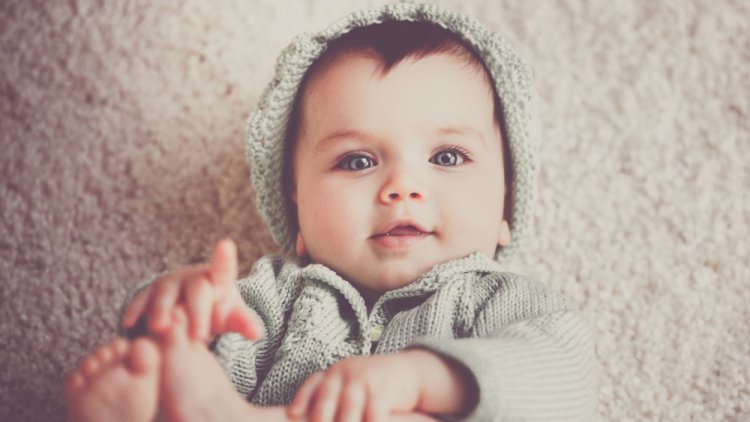
The 11th month of the baby's life
Summary
1. Observations
2. Deprivation of extended space
3. About baby's freedom of movement
4. Empathy
5. Games
6. Posture and motricity
7. Personality
8. The sleep
9. Food
10. Communication
11. Tips
1. Observations
When your baby wants to fall asleep, he does not necessarily cry, but he will make sounds "aaa, aa, aaa," sometimes noisy or sometimes not.
Other teeth will appear, and you will notice that he wants to bite more like before.
Toothache, you can identify it after the baby's cry, after biting all sorts of objects.
He shakes hand with you and say "goodbye" to other people and knows how to applaud.
If you tell him "goodbye," he will do goodbye by his hand, if you tell him "very good," he will applaud, if you show him with his hand to sit on the pillow and sleep, then he will touch the cushion with his hand.
Regarding what you taught your baby to do a few months ago, you will now reap the fruits. When you say "very good," he will applaud, as you taught it in the previous months.
It will mimic you when you move your lips like when you eat, when you say "yes," when you laugh and when you pull healthy air on your nose.
If you have a hoarse voice, the baby will imitate you when you adjust your voice.
It will imitate what you are doing, as the others say, it will play bo-peep.
When a person laughs or cries, your baby will imitate him.
The baby has learned to throw the ball.
Also, he will put the ball in your hand to throw it and for you to play with him.
In winter, looking out the window, the baby will stretch his hand in the air as if he caught the snowflakes.
You will find that the baby will laugh very hard when you touch him under his neck.
For the first time, if your baby likes a particular person, because you say that a baby feels the good soul of a person, then the baby will not start crying. So there are people who can achieve this performance and cannot make a baby cry, on their first visit.
You will notice that when you make your baby a massage on his hands and feet, he will sit on his belly and will love it.
The baby will look curiously at his shadow because of artificial light.
If you are sad, your baby will come to you and will touch your eyes, the face with his hands and will sit on your belly.
This month may be the first time the baby will hide something from you (e.g., the phone).
The baby is the bond between you and your partner. You will notice how your baby will hold a hand on you and the other on his father and how he will look at you, and then the other.
The notion of property in the baby
If a baby has a crib with a zipper, he will begin to get his stuff in his crib.
2. Deprivation of extended space
If you get into the baby's crib and the baby will be outside the crib, you will notice that he will cry because he is not with you. He does not want space but wants to be near you even if he does not like his cot of a baby.
So a baby does not cry because it is private of extended space, but because it is not with his mother. If your baby is with you, either in a small or large area, it does not matter the space, but to be where you are.
For the first time, he will hold you by your throat because he does not want you to go next to him.
3. About baby's freedom of movement
If the baby has freedom of movement, for example, his crib allows him to get out of it or to enter it when he wants (e.g., a zipper), then he no longer complains and no longer feels constrained.
4. Empathy
If you are looking for any pain caused by your baby by mistake (the baby will scratch your hand by mistake with a fingernail, and now you will scream), the baby will notice and start crying, but calm it fast, saying your baby that you are alright and that you just tested his empathy.
5. Games
Open a flashlight and walk with your baby in his room. He will see the shadows of the objects in the room on the wall and your moving shadows. He will lift his hand to touch the shadows. He will be impressed. He will look at the flashlight and the shadows.
The baby will play with you and will laugh with you when it touches your head and your hands.
6. Posture and motricity
He will catch your feet and stand up and will not let you go.
He will stand for a few seconds without any help.
Unlike the previous months, the baby is now very well supported on his feet, keeping with his hands by particular objects.
The baby can swing his left-right head as a sign of sleep, or he needs your affection. Distract your child from this habit with toys.
If you tell your baby not to swing his head, and he will react positively, then this means that he voluntarily moves his head and that there are no other problems (ask the doctor for advice if this habit continues).
It is not necessary to insist very much because if you eliminate this habit, it will seek and develop other tics.
You can associate the headache with toothache (does not want to eat; he bites from the kitchen table, drowsiness).
If you notice that the baby stays on the tips, you can put his shoes on his feet for 5-20 minutes to correct his walking.
7. Personality
If the baby returns a toy and can not put it in its place, your baby will be frustrated, but that does not mean that he will cry every time. But, for example, he will cry if you do not give him the object out of your hand, but only after he touches it, if he has not felt that thing yet, does not cry if you do not give it to him.
The baby at this age is arrogant, ambitious, and strikes with a hand, pushing and crying.
Before falling asleep, talk to your baby about your dreams, your memories. He will come back from the pillow, he will touch your mouth, and occasionally sigh until he falls asleep.
The baby is very attentive to everything around him. For example, when he sees a sparrow in the sky, he will lift his hand in the air. Initially, you may think the sun is in his eyes, but not, you will notice that the baby will also point his finger to the bird, a sign that he has seen it and is more careful than you. He will observe absolutely everything from his angle, and in the meantime, you will be the one who will omit specific details.
As a parent, you will get tired and your baby will notice this and will come to you and will laugh. He will make you smile, and he will get close by your nose and look straight into your eyes.
A baby is exceptionally kind when you will notice that he will not cry at all because of his teeth, but he will try to make you laugh and feel better.
8. The sleep
The 11-month-old baby can sleep twice a day after meals.
Before his sleep, the baby will imitate your sounds.
Show your baby a picture with a baby who sleeps, and he will start to move his head as he is preparing for sleeping.
9. Food
Concerning food, you can enter spinach, poultry liver, cornflour. Give him meat five days a week.
10. Communication
You can say a lot of words and show with your finger at you when you refer to his mother. And you can show him when you pronounce his name.
The baby will try to pronounce your name.
Then you can name the parts of the head, and you can exemplify it with your face.
Your baby, even if it is so small, understands more than you think.
You have to explain to him and do not hide things from him, because then, the baby will go directly to what is forbidden.
11. Tips
Before you make all the mandatory vaccines to your baby, you should avoid older, unvaccinated children!
The baby should not develop a fetish, such as children who reach a higher age and who are addicted to particular objects (a toy/a blanket).
Be careful when the baby will sit in the kitchen seat because it will start to stand up (put the belt)!
For more information, see the text 1-year-old baby.


